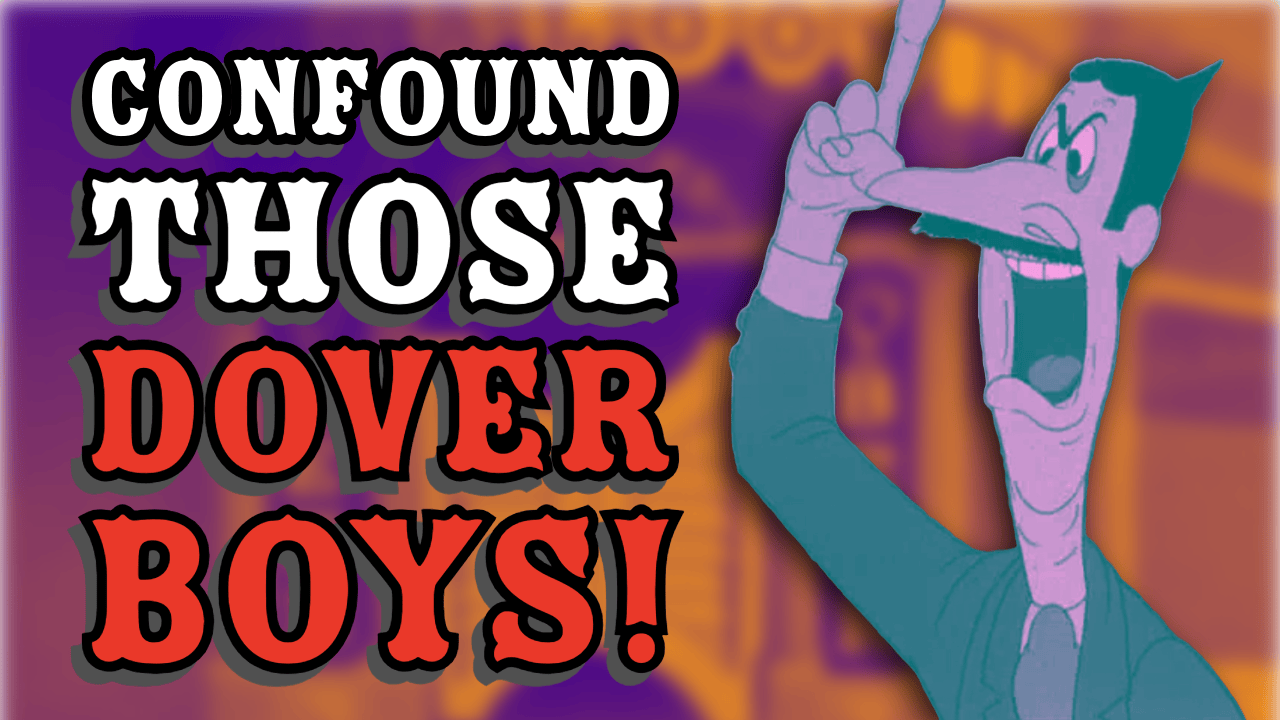
Confound Those DOVER BOYS! How Did They Get So Popular?! (“Dover Boys of Pimento University” Review)
Originally posted to YouTube on Jan. 26, 2024.
So, this is officially the oldest thing I’ve reviewed for this series–that is, unless, in the future, I decide to review a black-and-white cartoon from the 30s or 20s. Or a Winsor McCay short from the 1910s. Or maybe even that Horse in Motion footage from the first film recording in 1878.
Or maybe not.
So, “The Dover Boys at Pimento University.” If you’ve never heard of this short–you’ve heard of this short. If you’re terminally on-line like myself, chances are you’ve either watched the full cartoon, or you’ve seen it referenced, memed, and even remixed.
Hard to believe this obscure 80-year-old cartoon became quite the viral sensation in recent years. But why? How did a Merrie Melodies cartoon from the 1940s parodying a book series from the 1910s become so popular in the 2010s? Well, I guess that’s the question I’m here to answer in this review.
Released on September 19, 1942, produced by Leon Schlesinger and directed by Chuck Jones, this is the animated short “The Dover Boys at Pimento University (or The Rivals of Roquefort Hall).”
The short is a parody of The Rover Boys, a popular juvenile fiction series written by Arthur M. Winfield, with 30 titles published between 1899 and 1926. The stories follow the young protagonists–Tom, Sam, and Dick Rover–and their many wacky misadventures and shenanigans at the military boarding school Colby Hall.
The series was similar to other juvenile fiction series that were later published like the Hardy Boys, Nancy Drew, and Tom Swift with young protagonists solving mysteries and getting into trouble. However, while those series have become more well-known and famous, they owe their success to the influence of the Rover Boys, which essentially set the template for them.
So, what inspired an animated parody of this turn-of-the-century book series? Well, the most likely explanation is nostalgia. I’m sure most of you are familiar with the Nostalgia Cycle. According to the theory, media and trends that were popular 30 to 40 years ago become popular once again 30 to 40 years later when the people who were children back then grow up into adults.
Essentially, people who were children 30 to 40 years ago grow up feeling nostalgic for the media of their childhood and become adult consumers with enough disposable income to spend on merchandise to help them salivate their nostalgic yearnings. This is the reason why the 1950s was popular in the 1980s, and why the 1980s is popular today.
And so, as can be expected, in the 1940s, there was a similar nostalgic cycle for the 1900s and 1910s, as people who grew up during that time had since become adults. Now, I cannot confirm whether or not this short was created because Chuck Jones and the other animators had sincere nostalgia for the Rover Boys series, or if they were creating this short to appeal to Rover Boys nostalgia in film-going audiences at the time.
I do know, however, that this was not the only animated short themed to the turn-of-the-century. Several other studios created cartoons with throwbacks to that time period, including the 1941 Mickey Mouse short, “The Nifty Nineties”, and the 1947 Merrie Melodies short, “The Gay Anties”–a play on words to The Gay Nineties, which referred to 1890s America.
Of course, like most other nostalgic waves, turn-of-the-century nostalgia lasted well past the 1940s and into the 1950s. For example, did you ever wonder why Disneyland and other Disney Parks have a turn-of-the-century American town as their first themed land? It’s because Main Street USA was a loving homage to Marceline, Missouri, Walt Disney’s childhood hometown in the early 1900s. So, yeah, it was essentially created out of Walt’s own childhood nostalgia.
Think about that. If the park had been opened now, that land could have easily been themed to an American town in the 1950s. (You know, sort of like the Mel’s Drive-In Diner area in Universal Studios.)
The short opens proper with opening narration detailing the scenic yet quaint setting of Pimento University, a clear play-on-words to the Rover Boys school setting of Colby Hall, with plenty of other cheese puns throughout the short.
While Mel Blanc is the cartoon’s only credited voice actor, as was common with many Merrie Melodies and Looney Tunes cartoons, many of the characters in this animated short were evidently not performed by him. Most notably, the voice of the narrator sounds similar to that of John McLeish, who also served as the narrator for many Goofy cartoons. Though whether or not this is him remains unconfirmed. But the resemblance is quite coincidental.
We see our three main protagonists, Tom, Dick, and Larry–who are clearly based on the three Rover Boys, Tom, Dick, and Sam–as they make their way to another cheese pun, Miss Cheddar’s Female Academy, to pick up their girlfriend, Dora Standpipe (named after Tom Rover’s fiancée Dora Stanhope). Dora is voiced by Marjorie Tarlton, who also voiced other minor characters in Warner Bros cartoons, including Sniffles the Mouse.
The three boys and their fiancée make their way for an outing in the park. However, before they get there, they have to pass through an unsavory part of town where lurks the cartoon’s main antagonist, Dan Backslide (based on the Rover Boys antagonist Dan Baxter)–and you know he’s the villain because he smokes cigarettes, drinks beer, and plays billiards.
Okay, the last part is probably going to require some context.
Nowadays, we consider billiards to be a family-friendly game, as pool tables are commonly found in family-friendly establishments like arcades, recreation centers, and bowling alleys. However, when they were first introduced in the 1800s, pool tables were often located in saloons and bars, unreputable places filled with unreputable people who engaged in elicit activities like drinking, smoking, and gambling. In other words, billiards was a game that no respectable person would be caught playing.
This is the reason why in Disney’s animated Pinocchio, billiard tables are shown as one of the many other vices on Pleasure Island along with beer and cigars. It’s also the reason why in the 1962 musical The Music Man, the main protagonist Harold Hill is able to convince the town people to invest in a school marching band by drumming up a moral panic surrounding–gasp!–a pool table.
Anyway, circling back to the villain, Dan Backslide is voiced by Mel Blanc, and his design is based on animator Ken Harris. He is, without a doubt, the best part of the cartoon. His melodramatic, over-the-top acting makes him an exemplar of the TV Tropes concept of Narm, which is when the state of cheesy dialogue and overacting reaches critical mass, when a moment that is supposed to be taken seriously becomes unintentionally hilarious. Narm is what takes a good villain and makes them a great villain. All of the great villains are narmy as all get-out and loving every second of it.
Dan Backslide is Narm personified. He is literally a mustache-twirling villain who kidnaps helpless maidens so that he can place them in peril. He is a total ham-and-cheese sandwich who is constantly chewing all of the scenery all of the time. Honestly, how can you not love the guy when he makes such excellent line deliveries like this?
Oh, by the way, there’s also a running gag where some guy dressed in an old-timey bathing suits struts across screen to the tune of “While Strolling Though the Park One Day.” I have no idea whether this is a reference to something or if it’s a non-sequitur.
So, Dan Backslide steals a car and heads over to the park to kidnap Dora. He takes her to a cabin to have his way with her, but despite being a stereotypical damsel in distress, while Dora is helpless enough to be taken hostage, she isn’t quite as helpless as to not be able to defend herself when need to–specifically when that need is to be funny.
The Dover Boys eventually learn of Dora’s kidnapping and, being the heroic gents that they are, rush over to save her–but not without breaking into song with vocal harmonies provided by The Sportsmen Quartet, as were featured on Jack Benny’s radio program.
Wacky shenanigans ensue. Dan Backslide gets his lights knocked out, along with the Dover boys. And the cartoon ends anti-climatically with Dora Standpipe walking off with the running gag character.
So, now we have to answer the question, how did this obscure Merrie Melodies cartoon become so popular in recent years?
Well, I guess one reason is that the animated short is so easily available due to it being one of the many Warner Bros. cartoons in the public domain.
While Looney Tunes and Merrie Melodies have become synonymous with Warner Bros., the truth is that the company didn’t always have respect for its animation. (And, in many ways, it still doesn’t.)
In fact, Jack Warner, one of the original owners and founders of Warner Bros., was infamous for believing his company made Mickey Mouse cartoons. That’s right! The owner of Warner Bros was so clueless about his studio’s animation department that he thought it created the cartoons made by its main competitor.
So, while Disney was extremely protective of its animation, to the point of lobbying to subvert copyright law to keep many of its animated shorts from passing into the public domain–well, until recently, that is…
But while Disney was protective of its animated shorts, Warner Bros., not so much. The company would end up selling many of its shorts to other studios, and even proved so negligent that the copyright for many other shorts would inevitably expire, allowing them to fall into the public domain.
Now the rights and ownership of the Looney Tunes is a complicated and convoluted history. If you want to learn more about that, I’d recommend watching either KaiserBeam’s “The Merrie History of Looney Tunes” series or the PopArena Nick Knacks episode on the “Looney Tunes on Nickelodeon.”
However, according to the Looney Tunes Fandom Wiki, more than 150 Looney Tunes and Merrie Melody cartoons are in the public domain.
If you’re a child of the 80s and 90s like me, chances are you owned or watched VHS cartoon compilations of various animated shorts, many of which were Looney Tunes or Merrie Melody cartoons. These VHS compilations were possible because these shorts were in the public domain and thus smaller distributors were able to legally make these videos on the cheap.
Even to this day, you can find many of these cartoons on YouTube and other video streaming sites, either as individual shorts or cobbled together with other shorts in hours long compilations. And, of course, one of those shorts is the Dover Boys.
So that explains why the short was able to go viral, but the question remains as to why it became so viral. What was it about this obscure cartoon from the 1940s that allowed it to become so popular nearly 80 years later?
Well, perhaps the best reason is that cartoon is one of the first examples of a modern cartoon. I know, right? This 80-year-old cartoon “modern”? But, hear me out…
This may be hard to believe, but this Merrie Melodies cartoon was a radical departure from many animated shorts of its times.
Most other animated cartoons during that time aimed for “realism”–not in the sense that they tried to look like live-action, though that could certainly be said for many rotoscoped cartoons, but more in the sense that they often involved intricately designed character models with consistent proportions that often aimed to remain on model as often as possible.
Dover Boys, on the other hand, goes in the opposite direction. Its characters are highly stylized with abstract backgrounds and utilizes many techniques like limited animation and squash and stretch which would come to define animation in years to come.
The significance of this cartoon and its innovative animation style was noted by many animation historians. Many of whom called it “wholly unlike the animation of contemporary films.” In the book, “The 50 Greatest Cartoons”, animation historian Michael Barrier wrote:
“Chuck Jones [animated the short], going to extremes. Whereas Disney was renowned for its painstaking quality and detail, Jones deliberately set out to animate the story as crudely as possible, for humorous effect…[Doing so,] Chuck Jones stylized the animation in this cartoon in a way that anticipated what several consciously modern studios like UPA would be doing a decade later.”
Ironically enough, Chuck Jones was inspired to create this cartoon after his boss, Leon Schlesinger, urged him and his team to move away from Disney-like animation. However, when Jones screened the short to Schlesinger, he did not like it one bit.
In fact, as Wikipedia states, the studio executives were so disgusted by the cartoon that they wanted to fire Jones over it, and the only reason they didn’t was because they couldn’t find a replacement for him due to labor shortages caused by World War II.
That decision to keep Chuck Jones on board proved to be a good one, as he would become one of the most influential and famous of the Looney Tunes animators. However, this would not be the first time he would run into hot water with Warner Bros.
For example, a decade later, Warner Bros. would momentarily shut down its animation department, forcing Jones and other animators to find employment elsewhere. During that time, Jones would help work on a major animated feature. You might have heard of it. It’s called Sleeping Beauty! (That’s right! Warner Bros. animator Chuck Jones once worked for Disney.)
And while Dover Boys may have initially proved too radical for the higher-ups, the techniques it utilized like limited animation and dry brush smears would be popularized by other animation studios in years to come like UPA and Hanna-Barbara.
In fact, you could argue that the highly-stylized animation of modern cartoons–you know, the ones that are often derided as “CalArts style” by sad angry dorks on the internet–can trace their influences back to the stylized animation of the Dover Boys. So is it any wonder that this short became so popular by many modern cartoon fans? It is essentially the first modern cartoon.
Of course, the legacy of the Dover Boys has been recognized in other ways, as the characters have made cameo appearances in other Warner Bros animated productions.
One famous example was in the Animaniacs short, “Frontier Slappy”, where the titular Dover Boys are revealed to be the cartoon’s singing narrators.
And not only have the characters appeared as background characters in the movie Space Jam, they even appeared in many non-Warner Bros. media like Futurama and even Agent Carter. (Thank you, public domain!)
And so yeah, that’s the Dover Boys. What was once an obscure cartoon proved to have a bigger impact than initially expected. What was once derided by executives as “too radical” proved to set the standard for many modern cartoons, to the point where it was considered by some as the “first modern cartoon.” So is it any wonder that, nearly 80 years later, this cartoon would see a resurgence in popularity, to the point where avid fans re-animated the entire short? Including Viziepop. (That’s right. The person who made Hazbin Hotel and Helluva Boss contributed to this re-animation)
The Dover Boys, despite being set within a long forgotten time, proved to be an animated short ahead of its time. Its animation and humor prove just as good now as it did back then. Because this cartoon was really that good!
###
 J.C. Alexandre