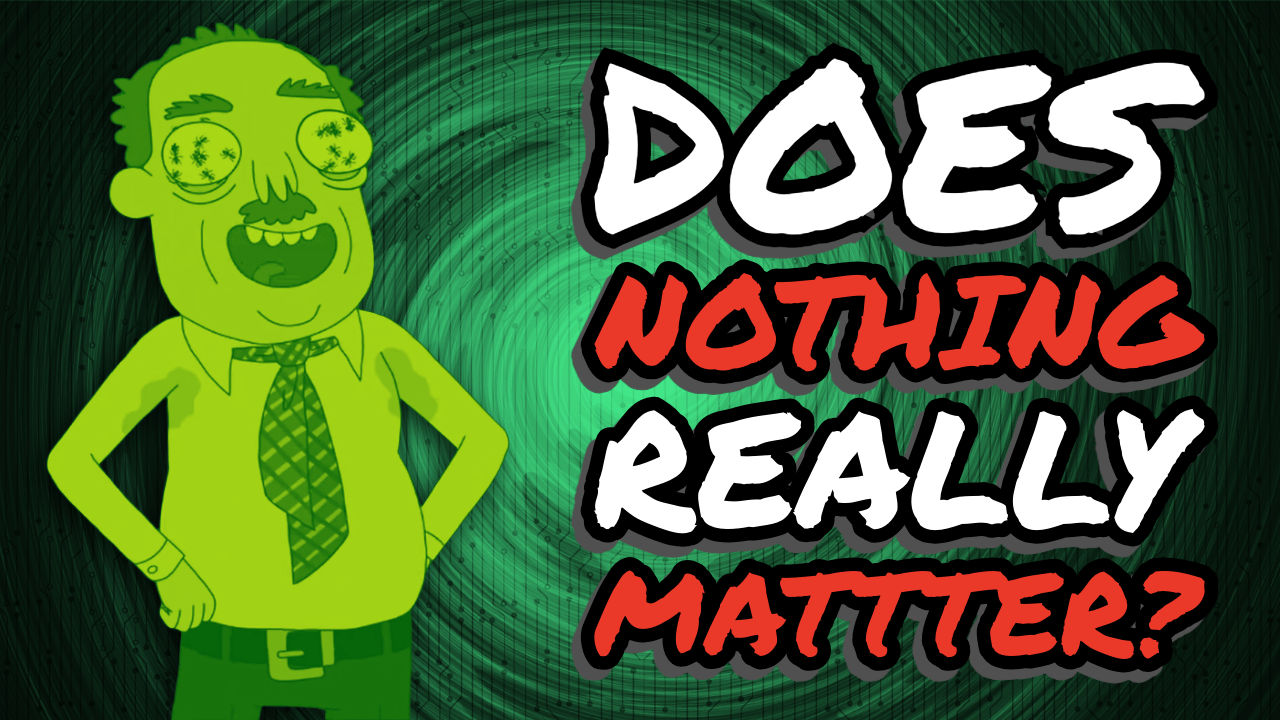
Wubba Lubba Dub-Dub! Does Life Really Matter? | “Rixty Minutes” Rick and Morty Review
Originally posted to YouTube on Mar 30, 2024.
So, Rick and Morty.
Contrary to popular memes, you do not need to have a very high IQ to understand Rick and Morty. In fact, if actual Rick and Morty fans are any proof, you don’t need an IQ at all.
Seriously, all you really need is a basic understanding of sci-fi tropes, because the whole appeal of the show is how it thoroughly and humorously subverts them.
Like, the show’s entire premise is essentially what if a character like Doc Brown or Doctor Who had all of the intelligence and none of the moral compass.
Boom. That’s the show. That’s the gist of it. A mad scientist and his grandson go on misadventures through time and space to thoroughly fudge it over.
That’s the show. That’s the appeal. No high IQ required. As is proved by actual Rick and Morty fans.
Now, if you were to ask Rick and Morty fans what the best episode of the show was, I’m sure you’d overwhelmingly get the most obvious answer.
And while “Pickle Rick” is undoubtedly an animated masterpiece, it’s also the most obvious choice, which is why I’m not reviewing it.
No, instead, the episode I’ll be reviewing is a personal favorite of mine. I, along with many other fans, consider it one of the best episodes–well, mostly because of its stream-of-consciousness parody of cable television, but also because it has a very thoughtful take on the show’s existential themes and an interesting angle towards the meaning, or rather, meaninglessness of life.
This is Season 1, Episode Eight of Rick and Morty, “Rixty Minutes.”
As with most Rick and Morty episodes, this episode has an A Plot with the titular characters and a B Plot with the rest of the family.
Let’s start with the A Plot since it the easiest and funniest to discuss.
When the Smith Family gets bored of watching reality television, Rick decides to upgrade the family’s cable box to allow them to watch channels from other dimensions.
The rest of the A Plot is simply Rick and Morty sitting on the couch and watching and riffing on interdimensional television.
Honestly, what makes these segments even funnier is how all of them were improvised. Now improv is a tricky form of comedy to master, especially if its for something other than improv theater. When it’s done poorly, it really sucks and shows how lazy the unfunny hacks trying to pull it off are. But when it’s done well, it’s the funniest crap ever. It really shows how Justin Roiland knows how to pull of improv.
This episode proved to be so popular that every season after it would have at least one similar episode where the characters would sit down and watch a bunch of television shows from alternate dimensions that are completely ad-libbed by the actors.
So, what else can I say about these segments that simply showing them won’t already accomplish? In other words, how can I possibly and needlessly stretch out this potion of the review?
And now, here’s all the segments from Rixty Minutes ranked from least funny to funniest:
15: Shmlo’s the Shmloss? Yes, this gimmick was so unimaginative that even Rick called it out.
14: A Guy Eating Poop. It’s literally a guy eating poop. That’s the joke.
13: Mr. Sneezy. It’s literally a car with a horn that makes a sneezing noise. That’s the joke.
12: Turbulent Juice. Dick jokes. For men who literally feel insecure about their own masculinity…and by “masculinity”, I mean their dicks.
11: Baby Legs. It’s about a cop with baby legs. That’s the joke.
10: Alternate Reality SNL. It’s Saturday Night Live, starring random crap Roiland thought up on the top of his head.
9: Trunkpeople. Yes, even in alternate dimensions, politicians still find marginalized people to scapegoat for their own political gain.
8: Quick Mystery. Don’t you just wish that most crimes were solved this easily in real life?
7: Ants in my Eyes Johnson. It’s those appliance sales infomercials. Only the salesperson has ants in their eyes. Yes, it’s a stupid concept, but it’s one of the few that’s so stupid it’s funny.
6: Fake Door Salesman. Honestly, what makes this fake commercial so funny is the fakeout at the end and the buildup leading up to it.
5: Dead Cat Lady. It’s literally Weekend at Bernie’s meets The Aristocats. Seriously, why hasn’t a real version of this movie been made?
4: Gazorpazorpfield. It’s a meaner version of Garfield with arms coming out of his head. And he likes enchiladas instead of lasagna. I especially like Rick and Morty’s conversation about Garfield’s voice actor. And I especially crack up at Roiland’s laugh at the end.
3: Ball Fondlers. What can I say? It’s pure unadulterated action and adrenaline. Pump that right into my veins.
2: Strawberry Smiggles. Hey, you know those cereal mascots that always f*** around with the children in their commercials who only want to eat their breakfast in peace? What if those children made those annoying mascots find out? And they do…in hilarious gory detail.
And the number one funniest Rixty Minutes segment is…
1: Two Brothers. The fact that Roiland is coming up with a movie trailer at the top of his head leads to everything in this scenario escalating to absolute hilarity…or rather, 12th gear.
Now let’s talk about the B Plot.
While flipping through the channels, Rick stumbles across a talk show where Jerry is being interviewed. Why? Because in that reality, he’s a famous celebrity who’s starring in the latest Hollywood blockbuster.
This piques the interest of the other family members, who want to know what their lives are like in other realities. So, Rick gives them a VR headset that allows them to see themselves in other dimensions.
Using the headset, the family discovers that, in the dimension where Jerry is a Hollywood star, that Jerry is a big name celebrity hanging out with other big name celebrities, Beth is a world-renowned surgeon who operates on people rather than horses, and Summer…uh, well…
Yeah, the family soon discovers that the other dimensions where Jerry and Beth are living their best lives are the same dimensions where Summer was never born, and the dimensions where Summer does exist are similar to their current reality where they’re all a seemingly boring family.
As can be expected, this revelation causes quite the existential crisis for the Smith family. Beth and Jerry get drunk and argue whether or not they should stay together while Summer decides to run away from home to sell turquoise or something.
While Summer is busy packing her bags, Morty decides to intervene. And here is where the episode gets especially thought-provoking.
For context, in a previous episode “Rick Potion #9”, Morty has Rick develop him a pheromone to get hot girls attracted to him. Things quickly turn awry, ending up with the entire earth’s population devolving into Cronenberg-style monstrosities.
Things become so irreversibly messed up that the only other solution is for Rick and Morty to bail out of their reality and find a new one to live in, specifically one where they’re dead. So, they leave their dimension and go into a new one where the two other versions of themselves were recently deceased.
This leads to a rather emotional scene where Morty is forced to bury the corpse of his other self and pretend to be that other version of himself while burying his traumatic guilt.
It’s rather evident in this episode that Morty is still grappling with that trauma. When he shares that with Summer, he uses it as an object lesson about how she shouldn’t worry about her own life because, in the end, none of us are meant to be here because, ultimately, life has no real meaning.
Now Rick and Morty, like many sci-fi stories of its type, operates on the concept of existentialism, the philosophical theory that life has no objective meaning or purpose because there is no inherent reason for human existence.
A more extreme extension of this philosophy, and the worldview most encapsulated by the show, is nihilism, which is a philosophical view that rejects generally accepted or fundamental aspects of human existence like knowledge, morality, or meaning because–well, if human existence is meaningless than nothing else ultimately has meaning.
Now, personally, I do not subscribe to either existentialism or nihilism. I prefer to believe that the universe has purpose and life within it has meaning.
For one, I’m a Christian, so believing that the universe has meaning because God created it and gave it meaning is how Christianity rolls.
Second, I don’t really see anything positive coming from the belief that life has no meaning. If anything, all of the greatest achievements and accomplishments in human history were made by people who believed that life had purpose and strived to give it meaning.
In contrast, what notable accomplishments were made by people who felt life didn’t matter because nothing matters? What? Dadaism? If anything, that proves that only great things can come from people who believe that human life has meaning and purpose.
And third, existentialism, and more specifically, nihilism, seems to be a worldview overwhelmingly held by mostly straight white dudes. Not to overgeneralize, but when you’re accustom to privilege and face no real obstacles in your life due to your personal identity, you’re tempted to believe that life has no purpose because you face no real challenges to your life and livelihood. Whereas, any person from a marginalized identity who has had to fight tooth and nail for their own right to exist on this planet will tell you that, yes, life has meaning because they have to constantly fight for it.
Now, if I were to endorse nihilism…which I don’t…I would more than happily endorse “positive nihilism” over “negative nihilism.”
What do I mean by that?
Well, apparently, there are two types of nihilism. The first is “negative nihilism”, which is what most people think of when they hear the term “nihilism.” The belief that the universe doesn’t have purpose, life has no meaning, and any attempt to ascribe meaning or purpose is inevitably futile and pointless.
Taken to its extreme conclusion, negative nihilism could lead people to either abandon all hope and wallow in despair over the overall meaningless of life or have them cynically think that any attempt to care about or believe in anything is stupid. The type of nihilism that inevitably leads people to recklessly abandon all concepts of morals and ethics because nothing matters so you might as well do what you want because you only have one life to live. YOLO!
This is the type of nihilism Rick Sanchez epitomizes. He is literally a super genius who has the intelligence and power to bend reality over backwards and make it his bitch. So, he does whatever he wants without any regards to his actions or their consequences simply because he can; and if he messes up, he simply escapes his current reality and starts over in another. Because, in the end, nothing matters.
Rick Sanchez is Nietzsche’s Übermensch. He is Ayn Rand’s “ideal man” who embraces selfishness as virtue. A man who perseveres to achieve his values and only his values. Because in this nihilistic mindset, the self is the only aspect that matters. I’ve got mine, fuck everyone else.
I’d argue this is the sole reason why so many fanboys love Rick and Morty. It’s not because it’s an “intelligent” show for people with a high IQ. It’s because it’s main character is their ultimate power fantasy: a super smart big boy who can do whatever he wants because he has the power to do whatever he wants, consequences be damned. It’s the white male power fantasy of never facing consequences for your actions.
And, well, despite all this, does having all this unlimited intelligence and power make Rick happy? No, not really. Despite Rick being idolized as a power fantasy , the show goes out of its way to show Rick isn’t really living his best life. Despite having the ability to do what he wants, being able to do what he wants doesn’t really give him satisfaction.
As the Good Book says, “What does it profit a man to gain the whole world and forfeit his soul?
On the flip side is “positive nihilism”, otherwise known as “optimistic nihilism”, as oxymoronic as that sounds.
Positive nihilism posits that an individual can create their own meaning after fully accepting that the universe is a large place of meaninglessness.
As the psychotherapy counselor Louis Laves-Webb explains, positive nihilism “views the belief that there is no underlying meaning to life from a perspective of hope. It’s not that we’re doomed to live in a meaningless universe–it’s that we get the chance to experience ourselves and the universe we share. The optimistic nihilist looks at a world lacking meaning and purpose and sees the opportunity to create their own.”
In other words, whereas negative nihilism insists that life has no meaning so nothing matters, positive nihilism insists that life has no meaning so everything matters. It’s less “nothing matters so I do what I want” and more “nothing matters so I’ll work to leave this world better than I found it.”
We have one life to live on this earth, so we should live it for the betterment of ourselves and others. Because, in the end, all we have is each other.
I feel this “positive nihilism” is best exemplified in Morty’s speech to Summer, especially the closing line of, “come watch TV with me.”
Yes, I know that was most likely a throwaway line with no real deeper meaning behind it, but, if you think about it, it does solidify the idea that the only thing we can know to be real is our relationships with other people.
I sort of touched upon a similar philosophy in my Fraggle Rock review:
“Whether you consider it an act of God or the result of scientific principles, our lives are a miracle. Our life is a miracle. And its up to all of us to use that miraculous gift to the best of our ability, and that’s best achieved by experiencing that gift with others through our connections and relations with one another.”
Essentially, if we really are just insignificant specks floating around this big empty universe on a big spinning ball, then we might as well use what little time we have in this big empty universe to foster relationships with the other specks on this planet we call Earth.
Because, in the end, the real meaning of life is the family and friends we make along the way.
(Or, you know, you can accept Jesus Christ as your personal LORD and Savior and seek meaning through him. Because that’s correct!)
This theme of “positive nihilism” and meaning through relationships with others is especially hammered in hard at the end of the episode, where Jerry discovers that the famous version of himself is in the middle of a naked, drunken police chase. Meanwhile, Beth is in the other room sipping wine and observing her other, more famous self.
These two instances essentially intersect with each other as the other Jerry is discovered to have been rushing over to the mansion of the other Beth. There, Other Jerry tells other Beth that he hates his life as a celebrity and wishes that he had married her instead. The two then embrace and accept that they would have been better together. And the episode ends with the real Jerry and Beth making up and realizing they were already living their best lives together.
Ah, now that’s a sweet couple. I sure do hope they have a long, lasting happy relationship.
Rick and Morty is a smart show, but not for the reason fans insist it is. This is not a smart show because it’s for smart people with very high IQs–again, as the existence of actual Rick and Morty fans will attest.
This is a smart show because, funny jokes and sci-fi references aside, its plots and themes get you thinking about humanity from a larger perspective. It gets you wondering about the larger scope of existence and where humanity fits into it all.
If you just come for the power fantasy of being like Rick Sanchez, you’ll simply leave with a shallower understanding than when you arrived with. But if you come with a curious mind like Morty and contemplate the broader aspects being portrayed, you’ll probably walk away with a refreshed view on life, the universe, everything.
Because that’s what good sci-fi does. That’s what all good stories do.
###

