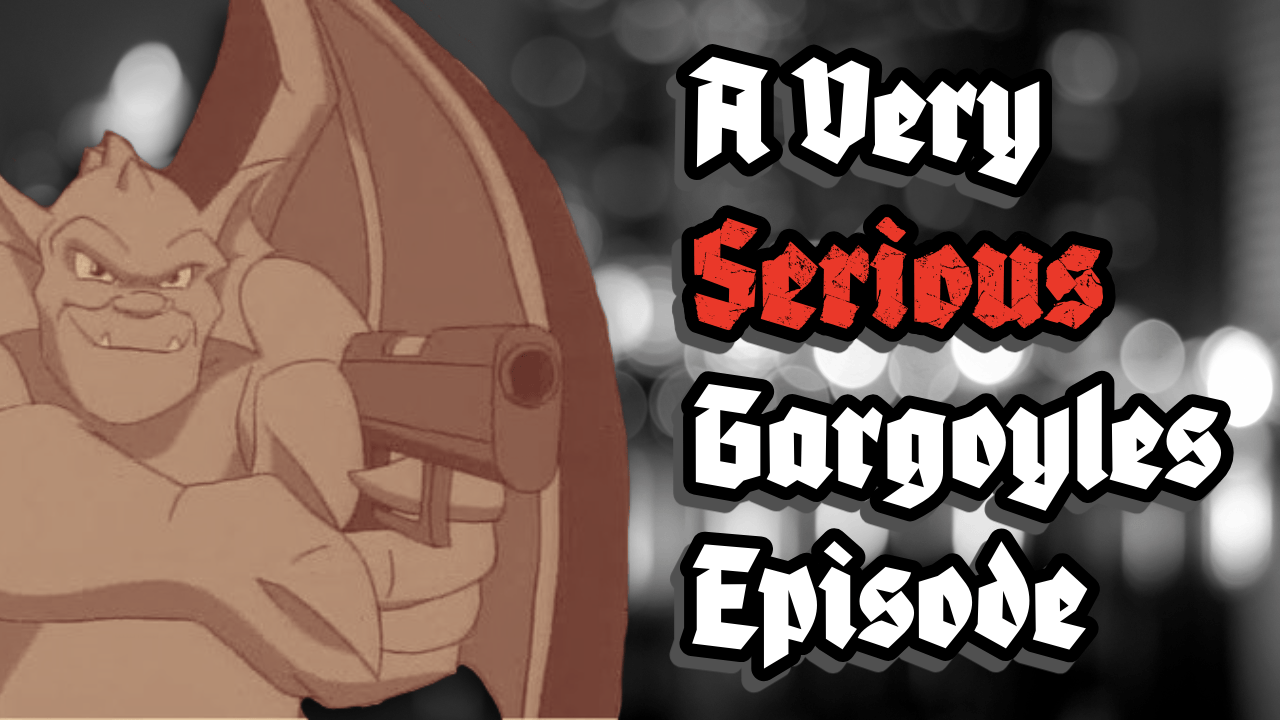
A Very Serious Gargoyles Episode (Gargoyles “Deadly Force” Review)
Originally posted to YouTube on Nov. 10, 2023.
Gargoyles was one of those shows that, despite coming out during my time, I never had the opportunity to watch, either because I was unable to or simply because I wasn’t interested. Now that I have Disney+, I’ve been catching up on the show, and I can now see why it’s gained a reputation as a nostalgic cult classic.
Disney really wanted to create its own show like Batman or Ninja Turtles that it could market to the young male demographic, and despite the fact this show received three seasons (though the quality of the third season is highly contested), the ratings and toy sales simply weren’t there and the franchise never took off.
However, as I mentioned, the show has since gained a cult following and had been reappraised by online reviewers and media critics. Gargoyles is now considered one of the unsung, underrated classics of the Disney Afternoon, and Disney has been profiting off of this nostalgia through merchandise and cameos in other media like video games. The show is even planned to receive a reboot on Disney+.*
And, can you really blame them? This show is excellent. Yes, it’s Disney blatantly ripping off Batman and Ninja Turtles, but in doing so, it created something that truly shines on its own. It’s an exciting adventure series with high-octane action, stunning visuals, compelling characters, and plenty of dark and mature material–making it quite the stark contrast to the more light-hearted comedies on the Disney Afternoon block.
Gargoyles was dark. Gargoyles was serious. And it wasn’t afraid to touch upon serious subject matter like discrimination and violence. And it’s violence that’s the subject of the episode I’ll be reviewing today. This is episode eight of season 1, “Deadly Force.”
Before we begin, a little context. Gargoyles is a show about–well–gargoyles. By day, they sleep silently as stone statues; but by nightfall, they come to life as mighty-winged creatures, sworn to protect the buildings where they roost.
The show is about a clan of gargoyles led by Goliath. They once lived in a castle in medieval Scotland before being placed under a spell that made them sleep as statues for a thousand years. They were awoken by a businessman, Xanatos, who sought to use them for his own nefarious purposes, but, with the help of policewoman, Elisa Maza, they were able to thwart his plans.
As of this episode, Xanatos is still in prison, yet even from behind bars, he still oversees various underground criminal operations, including the selling and trafficking of high-tech weaponry. It’s here where we start our episode, with Eliza Masa investigating the recent robbery of a shipment of highly-advanced weapons created by Xanatos’ company.
Meanwhile, one of the Gargoyles, Broadway, has snuck into a movie theater to watch a Western. (Side note: Were there actually any Westerns released during the 90s? I thought they went out of fashion after Heaven’s Gate bombed at the box office. But I digress…)
Anyway, the other gargoyles inform Goliath about how much Broadway fell in love with the movie ever since they first watched it two days ago. The older gargoyle, Hudson, evidently not in tune with the younger whipper-snappers, merely shakes his heads and comments: “Between movies, television and video games, it’s hard to tell reality from fantasy these days.”
Remember this line. I’m going to bring it up and discuss it later.
Later on, Elisa returns to her apartment following her shift and hangs up her coat and gun. Soon Broadway arrives, having finished watching his movie, and Elisa offers to make him dinner.
While she’s busy cooking, Broadway appears evidently enamored with the movie he recently watched, quoting lines and pantomiming the actors. It’s then that he sees Elisa’s gun hanging from her belt on her coat rack.
Having only seen these types of weapons in the movies, Broadway is eager to see and touch one in real life. He takes it from its holster, he touches it, he even handles in and aims it. And then…
I can’t stress enough how surprising it was for a scene like this, for an episode like this, to have aired on broadcast television in afternoon syndication during the time it was released.
Violence in children’s media, especially cartoons, has always been toned down for the sake of its child audience. This is especially true of gun violence, which was rarely, if ever, shown, and if it was shown, it was with science-fiction level weaponry that shot rays and lasers.
Even G.I. Joe, a cartoon show based on a toy line glorifying the American military, had to be constrained to showing characters using ray guns and surviving explosions.
And remember back in the mid-2000s when 4Kids had the syndication rights to air the English dub of One Piece, and they had to edit the show, which was originally made for an older audience, for children on Saturday morning television? How they censored all the guns in the show to either ray guns or…whatever the heck this was supposed to be?
The only notable exception I can think of off the top of my head is Batman: The Animated Series, which did show characters using real guns, but only rarely, and even then, they could only show characters using guns but never characters getting shot.
So, again, I cannot stress enough how miraculous it was for a scene like this where a character is shot nearly dead with a gun, a real gun with real ammo, to have aired on broadcast television in afternoon syndication. Something like this was unheard of.
And, to be expected, it proved quite controversial.
Shortly after this episode aired, it was quickly pulled from rotation. It later started re-airing on television, but with significant edits. The original episode showed Elisa lying in a pool of her own blood, but later re-airings censored the blood out. Even the episode on Disney+ has the blood removed.
Even then, we still see the consequences of gun violence in quite vivid detail. Elisa lays still, quiet, stiff, nearly cold on her apartment floor. Broadway rushes over to check on her. She proves unresponsive to his voice. Her eyes remain unopen and still. All of this shocks Broadway to his core. The violence that just occurred wasn’t like that in his movies. This was real and deadly.
He flies her to a nearby hospital and lays her on a gurney. He pulls back his hands to see them stained with blood–her blood, the blood from her gunshot wound, the wound that he gave her.
Again, this particular scene was edited for re-airings, but still, the fact it was shown at all is quite spectacular. Regardless of the edits in subsequent re-airings, this episode shows in quite vivid detail the consequences of gun violence.
And it had to.
The creators evidently wanted to drive home its message about the danger of guns to its young audience–and while fantasy weapons like ray guns do exist in this show, a real gun with real ammo had to be used to convey this message.
After all, children don’t need to worry about handling ray guns. Those types of weapons don’t exist. But real guns with real ammo do, and they are dangerous, very dangerous. Those are guns children do need to worry about in real life, so that was the gun used for this episode.
I won’t rehash the entire episode, so I’ll quickly recap the rest.
Goliath and the other gargoyles soon get word that Elisa was shot and sent to the hospital, and they assume she was attacked by the gang she was investigating and they go in search of the criminals.
Meanwhile, Broadway has hidden himself away from the others, riddled with guilt over nearly killing Elisa. He later encounters one of the gang members testing out the stolen weaponry in the woods. Having seen the dangers that regular guns can wrought, he destroys these weapons, not wanting anyone else to suffer a similar, if not worse fate, than his nearly killed friend.
All the while, Elisa is in the hospital, comatose and in critical condition. So severe is her injury and state that her relatives have been contacted to visit her. They fear this might very well be the last time they ever see her again.
Her condition worsens, and the doctors attend to her and her injuries. Again, we never see any blood or even the wound, but the sheer intensity of these scenes reveal how severe Elisa’s condition is. There’s a real sense that her injuries are mortal and that she very well may not survive them.
Goliath eventually apprehends the leader of the gang and, still under the assumption that he shot Elisa, he’s about to get his revenge when Broadway swoops in to confess that he shot Elisa.
Having nearly killed an innocent man–well, innocent of the crime he was suspected of committing anyway–Goliath merely restrains the gang leader and leaves him to be taken into custody.
The episode draws to a close with Elisa in the hospital, having survived her ordeal and recovering from her wounds, and Goliath and Broadway return to the other gargoyles.
Broadway, having evidently received a good talking to from Goliath, and having suffered the guilt of nearly killing a good friend, vows to never touch a gun again.
Remember that quote from earlier? How hard it is for some people to tell the difference between fiction and reality? That could have easily led to a lesson about violent media. And it very well could have gone in that direction.
Remember, this show aired in the mid-90s, a time when parent groups and political pundits preached against violent media and scapegoated it for real-life violence. This was a time when there were Congressional hearings where elected politicians testified against violent video games, citing notorious examples like Mortal Kombat and Night Trap–a schlocky horror B-movie video game that would have otherwise faded into obscurity had it not been used as evidence in a Congressional hearing about how video games inspired violence.
Needless to say, many shows often ran with this angle, preaching about how violent media made people violent. And given the context of this episode, whose story involves a character watching a violent movie, it could have easily ran with this message.
But it wasn’t, and for good reason.
(Well, two good reasons.)
For one, it would have been extremely hypocritical for a violent cartoon show to preach against violent media, which is why it didn’t.
And two, which goes without saying, because violent media does not make people violent. Violent media does not promote violence. Violent media is not the problem. Tools used to commit violence, like guns, are. Guns are the problem. Guns are dangerous. And that is the message that this episode hammers in loud and clear.
Perhaps one good thing about this episode is that it ends.
I know, right? All episodes end. But hear me out:
What I mean is that the episode just ends—without trying to spoon-feed the audience the moral of the story.
And remember, this was the 90s. Many children’s shows during that time concluded with public service announcements. He-Man. Ninja Turtles. GI Joe. Sonic the Hedgehog. Captain Planet. Even the original DiC English dub of Sailor Moon.
All of them had ending segments where they tried to shoehorn in moral lessons about health and safety in an attempt to pass the show off as “educational.” And while these lessons were helpful and well-meaning, they were also undoubtedly ham-fisted and preachy.
Gargoyles didn’t have those types of segments. Even then, special episodes in many shows like this often ended with the characters directly addressing the audience to discuss its special message.
And, again, this episode doesn’t do that. There’s no moment where Goliath and the other gargoyles break the fourth wall to tell the children at home about how “guns are bad, m’kay!” They don’t tell them that they should never touch a gun, how if they find one they should tell an adult, or how they can call or write their representatives to demand stricter gun legislation.
They don’t do any of that because they don’t have contempt for their audience. They trust that the children at home watched the episode all the way through and picked up on the very clear message it was trying to convey: “guns are dangerous and you should never mess with them.” They trusted that the viewers learned this lesson on their own and internalized it themselves. They didn’t need the characters to spell out that lesson for them one last time. Because this episode, this show, its creators, respected the audience.
Sigh.
So, I guess the question needs to be asked: could an episode like this be made today?
And my answer is, “no.”
But not for the reason you may think.
See, some people would claim this show couldn’t be made today because everyone’s too “woke” or “politically correct”, how the type of people who would complain about it are “sensitive snowflakes” or “social justice warriors.”
But that’s not the case. Even for its day, Gargoyles was rather “woke”–eh, that’s to say, socially conscious. Like X-Men, the show was about marginalized characters who experienced discrimination from larger society. The show was about characters facing prejudice.
In fact, Elisa Maza was specifically created to help drive in that message, as she was a character of mixed descent. Her father was a Native American, and her mother was Nigerian. She is, quite literally, a woman of color. She’s also a capable female character, though by no means perfect–which means that she would have been derided by some people as a “Mary Sue.”
Yeah, let’s be perfectly honest, if Gargoyles was made today, the only people who would be complaining about the show and its “wokeness” are people who unironically complain about wokeness.
No. The real reason this episode could not be made today is its portrayal of gun violence. Even when it originally aired, the episode proved controversial, as it was pulled from television before being re-aired with heavy censorship.
Gun violence in animated shows back then was controversial, and it’s still remains controversial today, if not more so. In fact, aside from adult animated shows, realistic gun violence is never shown in cartoons these days–and considering recent events, it probably never will.
I’d even say these limitations are the reason why many other modern cartoons that have attempted to discuss gun violence have largely failed. The two most infamous examples are the OK KO episode, “Let’s Not Be Skeletons”, which substituted guns with lasers that turned people into skeletons (get it?), and which proved to be so ham-fisted that the creator outright admitted that the episode was ham-fisted on purpose to be a satire of overt political messaging in cartoons.
The other example is the episode of the Animaniacs reboot, “Bun Control”, an episode explicitly caricaturing the NRA and its then president Wayne LaPierre and pushing a not-so-subtle message about gun control–only instead of using real guns, they use…bunnies.
Get it? It’s a pun! Bunnies. Guns. Gun Control. Bun Control. Ha!
Anyway, both episodes were notorious failures. For one, both were created for shows that were explicitly comedies, and it’s hard to make “serious” episodes about “serious” issues in comedies without completely alienating their comedic tone. Remember when Family Guy decided to make a “serious” episode of domestic violence, and most of that episode was making jokes at the expense of victims of domestic violence? Yeah, same problem there. It’s hard to make a serious episode for a show that’s not designed to be taken seriously.
But Gargoyles was a serious show. Though it had its fair share of comedic moments, the show maintained it overall dramatic edge, so it, unlike future cartoons, it was able to address a serious subject matter like gun violence. It took a real risk doing so, and, inevitably, it also suffered that risk with slight censorship, but overall, it succeeded in delivering its message.
Gargoyles was a show ahead of its time. In fact, it’s still ahead of our own time. And I hope that the announced reboot proves to do the old show justice. Because Gargoyles was a serious show and it took its audience seriously.
###
* CORRECTION: The Gargoyles reboot is no longer in production.

